

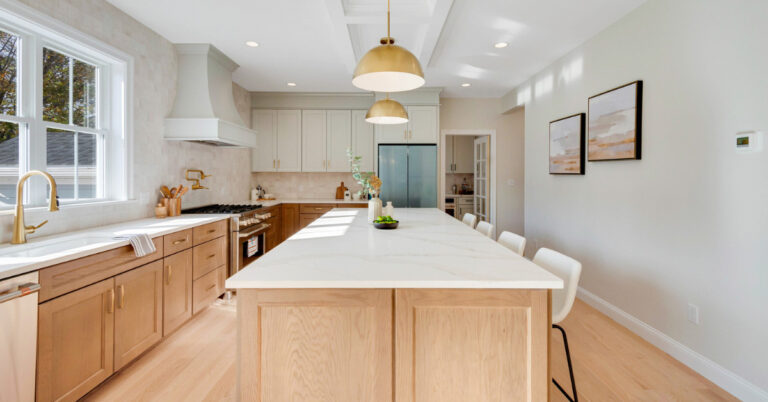
Last week, we shared the finished renovation at project Eastern Charm – a 1950’s cape makeover of the entire first floor.
The cosmetic changes are always talked about, but we don’t go into too much detail about the bones of the house.
Our clients, Mike and Maggie, wanted to get rid of their old and dated hot water heater. We knew right away that we’d suggest converting to propane, which would not only heat their home, but also power a tankless hot water system, and provide gas cooking.
Especially concerning older homes, it’s commonly assumed that converting your system is either not a possibility, or not worth the money.
Here’s a look at their family room before + after renovations. We vaulted their ceilings, installed new hardwood flooring, and the hidden highlight of it all: eliminated the ugly baseboards.
Installing a propane Tank: delivered by Eastern Propane & Oil
If you’re thinking about converting to propane, you should also think about the location for the tank. The tank is stored outside and it can be above or below ground.
Underground tanks are our personal favorite because they’re not sacrificing any space in your yard, and they boost your curb appeal by staying out of sight.
This option will be slightly more costly given the excavation needed, but could be a great option depending on the tank size you choose. Eastern offers underground tanks ranging from 325 to 1000 gallons.
The process of Converting to Propane
It may just look like a simple removal of the baseboards, but it’s definitely not a simple feat.
The tank had to be installed underground, the old baseboards had to be removed from each room, the old oil tank had to come out, and all new duct work had to be installed throughout the entire house.
The new System fueled by propane
One of the biggest pros of converting our clients home to propane is all the new appliance and system upgrades to go with the propane. Now, they have:
- Gas heat
- Tankless hot water
- Gas cooking
Is Converting to propane worth the money?
Now that we have gone over the tedious effort it takes to convert an old home, you’re probably wondering if it’s worth the labor and costs.
Here’s a quick overview of the benefits:
Installing a propane tank will cost you more up front, whether converting your home or installing into a new construction.
However, a propane-fueled furnace costs about $2,100 less to install and nearly $100 a year less to operate versus an oil-fueled furnace, according to research done by Newport Partners LLC.
Further, Eastern reported that over 90% of propane burned in the U.S. is domestically produced – which will always equal lower operating costs and more reliable price stability.
The environmental benefits of propane
Propane is a significantly better fuel alternative for the environment. In fact, it’s a designated clean energy alternative under the Energy Policy act of 1992. With propane you’ll benefit from:
- 12% lower CO2 emissions
- 20% less NOx pollution
- 60 to 70% fewer hydrocarbons
- 12% less carbon dioxide
- 20% less nitrous oxide
- As much as 60% less carbon monoxide as compared to gasoline
What else can propane power?
Besides heat and tankless hot water, propane can fuel:
- Traditional hot water
- Cooking
- Propane dryers
- Fireplaces
- Grills
- Outdoor hearths
- Patio heaters
- Back up power/ generators
A propane-fueled home has many benefits economically and environmentally – and our clients couldn’t be happier with their decision to convert from oil.
If you’re a resident of New England and thinking about making the switch, click here for more information or to get in touch with an expert!
Check out the entire project below:
Eastern Charm Project Reveal |
- 29 August 2025
Data and statistics from this blog post was sourced from and written in partnership with Eastern Propane & Oil


